Presbyopia - Why do I need reading glasses now?
We invite you to make an appointment and learn more:
480-981-6111
Derived from the Greek 'presby' and 'ops' meaning old-age sight, presbyopia
occurs because the eye's lens gradually loses its ability to change
shape when acted upon by the ciliary muscle - the smooth muscle within
the ciliary body that surrounds the lens.
Similar to grey hair and wrinkles, presbyopia is a symptom caused by
the natural course of aging. Presbyopia is not a disease and it cannot
be prevented.
The ability to focus on near objects declines throughout life. The
first symptoms are usually first noticed between the ages of 40-50.
Symptoms of Presbyopia
You'll likely become aware of presbyopia when you start needing to hold
print at arm's length in order to read it. If you're nearsighted, you
might temporarily manage the problem by reading without your glasses.
- Print appears unclear at a normal reading distance
- Eyestrain or headaches from prolonged reading or close work
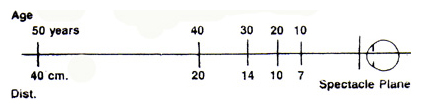
The near-point of accommodation gradually moves outward from about 10
inches (20 cm) at age 40, to 12 inches (30 cm) at age 45, and 16 inches
(40 cm) at age 50 years.
A basic eye exam can confirm presbyopia. You can correct the condition
with nonprescription reading glasses or prescription eyeglasses or contact
lenses. Surgery also may be an option.
Presbyopia, like other focus defects, becomes much less noticeable in
bright sunlight. This is not the result of any mysterious 'healing effect'
but just the consequence of the iris closing to a pinhole, so that depth
of focus, regardless of actual ability to focus, is greatly enhanced,
as in a pinhole camera which produces images without any lens at all.
Another way of putting this is to say that the circle of confusion, or
blurredness of image, is reduced, without improving focusing.
A delayed onset of seeking correction for presbyopia has been found
among those with certain professions and those with miotic pupils.
In particular, farmers and housewives seek correction later, whereas
service workers and construction workers seek eyesight correction earlier.
Causes of Presbyopia
| |
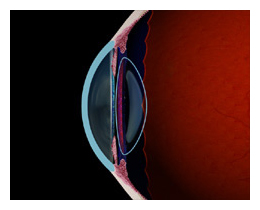
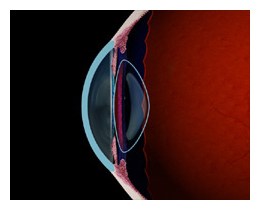
The elasiticity of the lens inside your eye.
(Move mouse over image to see it change)
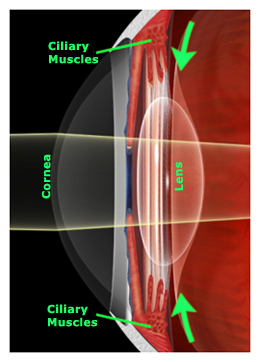
Ciliary muscles hold the
crystalline lens in place.
|
The exact causes of presbyopia are not known with certainty. Current
research most strongly supports a loss of elasticity of the crystalline lens,
although changes in the lens' curvature from continual growth and loss of
power of the ciliary muscles have also been postulated as its cause.
In order
to "create" an image, your eye relies on two structures
to focus the light reflected from objects: the cornea — the clear
front surface of your eye — and the crystalline lens inside the
eye, held in place by ciliary muscles (the muscles that bend
and straighten the lens). Both of these structures bend
(refract) light entering your eye to focus the image on the retina, located
on the inside back wall of your eye.
The crystalline lens, unlike the cornea, is somewhat flexible and can
change shape with the help of a circular muscle that surrounds it. When
you're looking at something far away, the circular muscle relaxes. When
you're looking at something nearby, the muscle constricts, allowing the
relatively elastic lens to curve more steeply and change its focusing
power.
Presbyopia and the 'payoff' for the nearsighted
Many people with myopia are able to read comfortably without eyeglasses
or contact lenses even after age 40. However, their myopia does not disappear
and the long-distance visual challenges will remain. Myopes with astigmatism
will find near vision better though not perfect without glasses or contact
lenses once presbyopia sets in. But, the greater the amount of astigmatism
the poorer their uncorrected near vision. Myopes considering refractive
surgery are advised that surgically correcting their nearsightedness
may actually be a disadvantage after the age of 40 when the eyes become
presbyopic and lose their ability to accommodate or change focus, because
they will then need to use glasses for reading.
Treatment of Presbyopia
Presbyopia is not routinely curable - though tentative steps toward
a possible cure suggest that this may be possible. Tthe loss of focusing
ability can be compensated for by corrective lenses including eyeglasses
or contact lenses. In subjects with other refractory problems, convex
lenses are used. In some cases, the addition of bifocals to an existing
lens prescription is sufficient. As the ability to change focus worsens,
the prescription needs to be changed accordingly.
Around the age of 65, the eyes have usually lost most of the elasticity.
However, it will still be possible to read with the help of the appropriate
prescription. Some may find it necessary to hold reading materials farther
away, or require larger print and more light to read by. People who do
not need glasses for distance vision may only need half glasses or reading
glasses.
While bifocals and multifocals offer a working solution to everyday
problems, they are disliked by many, especially engineers, camera operators,
and those used to having a good sharp distortion-free image in their
work. Varifocals cause straight lines to look bent, and can leave some
feeling dizzy after extended use. The power of simple, multiple prescriptions
should not be underestimated. Reading glasses hastily prescribed may
be fine for reading, but not good for shopping and generally walking
around in. A slightly weaker prescription however, just powerful enough
for reading using the full remaining accommodation of the eye, may feel
much more comfortable for more general use too. Careful calculation of
working ranges, together with a certain amount of trial and error, can
restore undistorted vision for critical tasks for many people who do
not find multifocals to their liking.
In order to reduce the need for bifocals or reading glasses, some people
choose contact lenses to correct one eye for near and one eye for far
with a method called "monovision". Monovision sometimes interferes
with depth perception. There are also newer bifocal or multifocal contact
lenses that attempt to correct both near and far vision with the same
lens.
Cataract Surgery for Presbyopia
Presbyopia affects just about everyone who has cataracts. In the past,
patients undergoing cataract surgery needed to wear eyeglasses, bifocals
or reading glasses after cataract surgery in order to see things at intermediate
distances or near distances. Lens replacement surgery with presbyopia
correcting lens implants such as ReStor offer cataract patients the opportunity to be less dependent
or even free of eyeglasses, readers or bifocals after cataract surgery.
Presbyopia begins because of the natural loss of elasticity of the crystalline
lens inside your eye. Thus, presbyopia is a problem of the lens, not
the cornea, and therefore it is the lens that must be treated if someone
truly suffers from presbyopia. New surgical procedures may also provide
solutions for those who do not want to wear glasses or contacts, including
the implantation of accommodative intraocular lenses (IOLs), such as
the ReStor.
Cataract surgery with presbyopia correcting lens implants allows most
patients the flexibility of having clear vision for far away tasks such
as driving and watching television, as well as for being able to read
the newspaper, medicine bottles and their mail-without depending on glasses.
This flexibility provides not just a solution to eliminating glasses,
but a functional convenience that allows cataract patients to conduct
their daily living activities in an unencumbered manner.
The eye specialists of East Valley Ophthalmology perform advanced
technology diagnostic testing and treatment, as well as taking
the time necessary to provide each patient with information needed
to fully understand their condition and to achieve their best possible
visual outcome.
If you would like further information, please call our office at:
480-981-6111
East Valley Ophthalmology
Eye Doctors - Mesa, ArizonaIf you or a family member
or friend have not had a recent routine eye examination, have a specific eye condition that needs addressing, or are looking for
an eye specialist or professional eye consultant please take a moment to Request an Appointment.
|