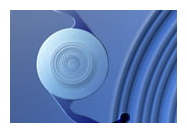
Aspheric ReStor Lens Implant
AcrySof Aspheric ReSTOR Apodized Diffractive IOL
Designed to Address Presbyopia.
East Valley Ophthalmology was among the
first in the world to receive the Aspheric ReStor
intraocular lens implant (IOL), a new surgically
implanted lens that results in patients ability
to see more clearly at a wider range of distances
without glasses or contacts. We invite you to make an appointment and learn more: 480-981-6111.
 |
|
Aspheric ReStor Lens Implant
The Aspheric IQ lens is designed to enhance contrast sensitivity, reduce
dependancy on glasses, and improve functional vision. The Aspheric
IQ lens offers these advantages over traditional intraocular lens
implants:
- Provides best vision for near and far distances.
- Improved contrast sensitivity.
- Filtered blue light protection.
- Rich, vibrant color perception.
|
It's a huge evolutionary step. We all want a
glasses-free and contact lens-free society and
we are very rapidly moving toward that. Reducing the
need for reading glasses after cataract removal,
without compromising distance vision, has been a goal of ophthalmology
for many years. Until now, the vast majority
of patients who undergo cataract surgery received
a single-vision lens implant, which typically requires them to
carry around reading glasses so they can read a newspaper,
menu or medicine bottle, or do other things that
require close vision.
Aspheric Design Advantage
Traditional lens implants are spherical, meaning
the front surface is curved. Aspheric ReStor
lens is slightly flatter in the periphery and
are designed to provide better contrast sensitivity.
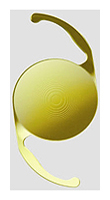
The AcrySof Aspheric ReSTOR lens is
a permanent artificial lens used to replace the natural lens during cataract
surgery. The ReStor lens is convex on both sides and made of a soft plastic.
It is folded and inserted into the eye through a tiny incision smaller than
the optic diameter of the lens. After insertion, the lens gently unfolds to
"ReStor" vision. The supporting arms of the lens maintain proper positioning
within the eye.
Meeting the Challenge of Presbyopia
The ability to focus at various distances is called
'accommodation', and is the normal condition of a youthful
natural lens. However, as we age, this lens becomes
more rigid and our ability to accommodate diminishes,
usually starting around the age of forty. This inability
to accommodate is called presbyopia. Presbyopia is
the reason that reading glasses or bifocals are required
as we age.
Aging also causes the eye's natural lens to become
more opaque, which scatters light and creates
cloudy vision. The opaque lens is called a cataract.
Traditionally, when a cataract develops,
the natural lens inside the eye is replaced with
an artificial IOL. Standard IOL's are single-vision
lens, which allow perfect vision without glasses
for one distance only, usually for distance.
Glasses would still be needed for near vision.
Apodization - An Entirely Unique Design
The ReStor lens has an uniquely shaped optic, called "apodization,"
that is entirely new to the field of ophthalmology. The Aspheric ReStor
IOL represents breakthrough technology because it treats the
refractive problem of presbyopia. It delivers consistent high-quality
accommodative-like vision across the entire visual spectrum
due to its patented apodized design.
While other
accommodative-type IOL's produce vision at various
ranges by depending on the action of the eye's ciliary muscles
to produce accommodation, the ReStor lens responds to how
wide or small the eye's pupil to distribute light between near
and far vision. Having both "refractive" and "diffractive"
surfaces, the ReStor lens works like two lenses in one. The
refractive surface is for distance and the diffractive surface
is for near. This amazing combination renders a lens implant
that is not dependent on the movement of the lens, making visual
outcomes more highly predictable.
Apodization is the gradual tapering of
the diffractive steps (illustrated below) from the center to
the outside edge of a lens.
This unique design optimally manages light energy delivered
to the retina because it distributes the appropriate amount
of light to near and distant focal points, regardless of the
lighting situation. Apodized diffractive optics are designed
to improve image quality while minimizing visual disturbances.
The result is an increased range of quality vision that delivers
a high level of spectacle freedom.
Diffraction involves the diffusing
or bending of light to multiple focal points as it passes
through the lens. The center diffractive area of the ReStor
supports near vision. The center of the lens
surface consists of an "apodized"
diffractive optic, a series of tiny steps in that center
area working together to focus light for a seamless transition
of near through distance vision.
Refraction involves the redirection
of light passing through the lens, to a single focus point
on the retina. The outer ring of the ReStor is the refractive
area that surrounds the apodized diffractive region and is
what allows you to experience distance vision.
Previous attempts using various multifocal lenses often resulted in
haloes and significantly reduced contrast sensitivity in low
light conditions. These issues are no longer a problem with the ReStor
lens. As well, unlike the blended vision monofocal implant option; there
is no loss of depth perception. Reading ability, even for fine print,
is markedly improved with the ReStor.
Is the ReStor lens for everyone?
The best candidates will be those that have a strong desire to see well
without glasses and have realistic expectations. While there are
no known contraindications, based on the FDA clinical trials, the
following types of patients should NOT have the Aspheric ReStor
lens:
- Patients who are satisfied with wearing glasses
- Patients who want guarantees on surgical outcomes
- Patients that are hypercritical with unrealistic expectations
- Patients with excessive complaints about their prescription
- Patients who drive at night for a living, or whose occupation or hobbies
depend on good night vision
- Patients who are amateur or commercial airline pilots
- Patients who have lifelong complaints about glare and halos or are
bothered by glare at night
- Patients with ocular disease may not be good candidates for
this implant.
Astigmatism is not corrected
with standard cataract surgery nor with the ReStor lens, but it may be address
with the AcrySof Toric IOL.
Medicare Approval of the Aspheric ReStor Lens
Medicare has announced revisions to its payment guidelines,
allowing patients covered for cataract surgery to choose the
ReStor lens at an added fee. Previously, Medicare payment rules
did not allow patients to choose this lens, which is highly
significant since the lens was specifically designed for this
age group!
The ReStor lens, and the care associated with the surgery to implant
it, is unique for Medicare recipients because it treats the
non-covered refractive diagnosis of presbyopia. For the first time,
Medicare is now allowing patients to choose this elective refractive
service. Patients with cataracts will still have their basic surgery
covered by Medicare and/or insurance, plus they may elect to pay out
of pocket for the upgrade of the ReStor lens and presbyopia treatment.
Refractive lens exchange, surgery patients without cataracts (who also
wish to be independent of glasses) would be responsible for the
whole fee as usual.
Aspheric ReStor Lens is FDA-Approved
This new artificial lens, which often can restore sight at near, intermediate,
and distant ranges following cataract surgery, has received
United States Food and Drug Administration approval. Although the
ReStor implant is new to the United States, it has had the CE Mark
in Europe (highest certification in Europe, a designation similar
to UL - underwriters
labs - in the United States) and there are many thousands already
implanted worldwide. The FDA clinical
studies supporting its approval showed that 80% of patients
who received the Aspheric ReStor lens did not use glasses for any
activities after cataract surgery.
FDA clinical trials and results:
The exceptional visual performance of the ReStor lens was independent
of pupil size and was accomplished by the optics of the lens,
without physical movement of the lens inside the eye, making
visual outcomes highly predictable. This is the first time this
level of spectacle independence has been achieved!
Approved for use in Europe since April 4, 2003, the ReStor lens received
FDA approval on March 23, 2005. During clinical
trials, 566 people received the ReStor lens. The ReStor
is made of the exact type of acrylic lens material that has been
in used in cataract surgery for years, in many thousands
of patients.
In an FDA Study:
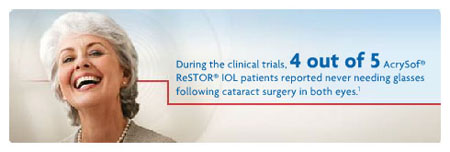
- 80% of patients
who had cataract surgery with the ReStor IOL in both eyes NEVER
wore glasses. Only 3% of patients always wore glasses.
- 84% of patients receiving the ReStor lens in both eyes
achieved distance visual acuity of 20/25 or better, and near
visual acuity of 20/32 or better without glasses.
- 94% of patients who had
ReStor put in both eyes, said they would have the surgery again.
During U.S. clinical trials, the results with ReStor were remarkable:
- 99%
of patients could see well enough to drive a car without glasses
or contacts
- 97% of patients could read the newspaper without
reading glasses or bifocals
- 90% of patients could shave
or put on makeup without glasses or contacts
- 74% of
patients could read stock quotes in the Wall Street
Journal without reading glasses or bifocals
The eye specialists of East Valley Ophthalmology perform advanced
technology diagnostic testing and treatment, as well as taking
the time necessary to provide each patient with information needed
to fully understand their condition and to achieve their best possible
visual outcome.
If you would like further information, please call our office at:
480-981-6111
East Valley Ophthalmology
Eye Doctors - Mesa, ArizonaIf you or a family member
or friend have not had a recent routine eye examination, have a specific eye condition that needs addressing, or are looking for
an eye specialist or professional eye consultant please take a moment to Request an Appointment.
|