|
Contact Lens Method.
The Contact Lens Method, originally outlined by Dr. Holladay, was once considered
a helpful way to estimate the average central corneal power following radial
keratotomy. This technique required a special PMMA contact lens, of a known
base curve and power. We have found the contact lens method to be less
accurate following other forms of keratorefractive surgery, such as LASIK,
LASEK, PRK, and ALK.
Following all forms of ablative keratorefractive surgery (LASIK, PRK, etc.)
a review of the literature now suggests that the hard Contact
Lens Method may be less accurate than originally thought. For this
reason it is no longer recommended in this clinical setting.
The information here is offered for historical interest only:
In this situation, the clinical relationship:
Cbase + Cpower + Rcl - Rbare = Ktrue
generally holds true, if the following are
known:
| |
Cbase
= base curve of the contact lens in diopters,and
Cpower = spherical power of the contact
lens in diopters, and
Rcl
= spherical equivalent refractive error with the
contact lens, and
Rbare
= spherical equivalent refractive error without the
contact
lens, then
Ktrue
= the estimated corneal power after refractive
surgery
|
To give accurate information, the refractive numbers (Rcl
and
Rbare
) must retain their corresponding plus (hyperopic) and minus (myopic) signs, and be corrected for vertex distance.
Example:
Before refractive surgery by 16-incision RK, a 48-year old male, with
high axial myopia, was found to have a refractive error in the left eye of
-16.00 +2.00 x 092 at a vertex distance of 12.0 mm.
Prior to refractive surgery, by both topography (simulated Ks), and
standard Javal-Schiötz keratometry, the central corneal power of the left eye
was found to be 42.00 x 002 and 44.00 x 092. Four years following RK, the
vision in the left eye is 20/20 without correction. The refraction has been
stable and is found to be -0.50 +0.50 x 092.
What is the estimated corneal power for this patient four years after
radial keratotomy?
Step 1 - Determining base curve of an over-refraction
contact lens.
Pick a 9.5 mm, reverse geometry, PMMA, plano contact lens with a base
curve somewhat steeper than what you might expect would be the true corneal
curvature. Any high quality contact lens laboratory can make a set of
these for you ranging from 30.0 D to 45.0 D in one diopter steps. A good
general rule of thumb is to use a contact lens base curve that is
approximately 95% of the average measured Ks.
For example, if the post-keratorefractive surgery measured Ks are
found to be 35.88 x 180 and 33.75 x 090, a good choice for the over-refraction
contact lens base curve would be calculated as follows:
Base curve = 0.95 * (0.50 * (K1+K2))
Base curve = 0.95 * (0.50 * (35.88 D + 33.75 D))
Base curve = 0.95 * 34.82 D = 33.07 D
and then round up or down to the nearest
whole diopter to arrive at the following final base curve to use for a
contact lens over-refraction:
Base curve = 33.00 D
(actual measured base curve is 32.95 D)
 Note: Our contact lens laboratory was instructed to list the measured base
curve for this lens to two decimal places. In this case, the measured base
curve of the plano, reverse geometry contact lens is 32.95 D. We will use
this number in our calculations. Note: Our contact lens laboratory was instructed to list the measured base
curve for this lens to two decimal places. In this case, the measured base
curve of the plano, reverse geometry contact lens is 32.95 D. We will use
this number in our calculations.
Step 2 - Determine the refraction with the contact lens in
place
With the plano contact lens in place, the over-refraction is -2.75 D
at a vertex distance of 12 mm. This would become -2.66 diopters at the
corneal surface.
A 12.0 mm vertex distance correction is determined as follows:
1/(-2.75 D) = -0.3636 m
-0.3636 m - 0.012 m = -0.3756 m
1/(-0.3756 m) = -2.66 diopters
| |
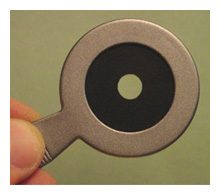
Trial frame pinhole occluder
with a 4.5 mm central opening. |
As recommended by Dr. Holladay, we have found that it is better to do
these measurements in the setting of a normal (non-dilated) pupil and with
an occluder placed in the black trial frame that has a 4.5 mm opening
drilled into its center. We then perform all refractions through this
"artificial entrance pupil." In this way, only the central portion
of the post- keratorefractive cornea is used to determine the refractive state
of the eye. Dr. Holladay is to be congratulated for this very helpful
insight, which further enhances the accuracy of these measurements. |
Step 3 - Estimate corneal power in diopters after refractive
surgery
Using the above information, the estimated corneal power is
approximately30.54 diopters.
| |
C
base |
+ |
C
power |
+ |
R
cl |
- |
R
bare |
= |
K
true |
| |
|
|
|
|
|
|
|
|
|
| |
(32.95) |
+ |
(0.00) |
+ |
(-2.66) |
- |
(-0.25) |
= |
30.54 diopters |
Note: Most contact lens laboratories will be happy to custom make a special set of reverse geometry 9.5 mm diameter plano PMMA contact lenses in 1.0 diopter steps, with base curves from 30.0 to 45.0 diopters specially for this purpose.
As described above, the laboratory should be instructed to list the actual
measured base curve for each lens. It is not uncommon to order a 36.0
diopter contact lens and have the actual base curve turn out to be something different. As the base curve is not being used for corneal fitting, but instead as part of a mathematical formula, the laboratory will need to carefully measure each contact lens and provide you with this information. Use this actual measured base curve figure when doing your corneal power calculation.
If you do not have a relationship with a contact lens laboratory familiar
with manufacturing a set of these special lenses, we recommend the
following:
Contex, Inc.
4505 Van Nuys Blvd.
Sherman Oaks, CA 91403
Tel: (818) 788-5836
FAX: (818) 788-5078
|




