Hyperopic LASIK and PRK.
Determining Corneal Power after Hyperopic LASIK.
For eyes that have undergone hyperopic LASIK, the central corneal
power estimation technique is much easier than for myopic LASIK. This
is thought to be due to the fact that the ablation takes place
outside the central cornea.
| |
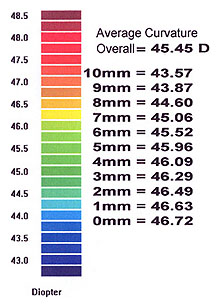
Zeiss Humphrey Atlas Topographer
Annular Ring Power from the Numerical View feature.
|
An interesting feature of hyperopic LASIK is that following this
procedure, the ratio between the posterior and anterior corneal radii
is increased, much like what is seen following radial keratotomy. For
this reason, it is possible to use a similar method of central corneal
power estimation. It is intriguing that a myopic incisional technique
(RK) and a hyperopic ablative technique (hyperopic LASIK), would alter
the posterior : anterior corneal radii ratio in much the same way.
Based on the experience of Drs. Wang, Jackson and Koch, the average of the
1 mm, 2 mm and 3 mm annular power rings of the Numerical View of the Zeiss
Humphrey Atlas topographer is sufficiently accurate to serve as a reasonable
estimate of central corneal power following hyperopic LASIK. However, depending
on the amount of hyperopic laser vision correction, a correction to the
average of the 1 mm, 2mm, and 3mm annular power ring value must be made.
Click
to view Numerical
View Correction Table.
As an alternative, Drs. Wang, Jackson and Koch have shown that the
effective refractive power (EffRP) of the EyeSys Corneal Analysis
System also works well.¹ Notice that this technique is very similar to
what is currently recommended for estimating the central corneal power
following radial keratotomy. As well, for this method, a small correction needs
to be made to the effective refractive power (EffRP).
Click
to view EffRP Correction Table.
Remember that some form of a "double K method" correction is
still required for IOL power calculations following hyperopic LASIK in order
to avoid a refractive surprise. This can be done by checking the "Previous
RK, LASIK, etc." box on the Holladay 2 formula (contained within the
Holladay IOL Consultant), or by using a hyperopic "double K method" IOL
power correction table based on the work of Aramberri for any of the
three popular 3rd generation, 2-variable formulas.
Double-K Method
Correction.
The recently introduced hyperopic version of the Haigis-L formula is also
very useful for patients who have undergone prior hyperopic LASIK. It is
a purely objective methodology that uses small zone keratometry and requires
no prior historical information.
Hyperopic Haigis-L Formula.
References
1. Wang L, Jackson DW, Koch DD. Methods of estimating corneal
refractive power after
hyperopic laser in situ keratomileusis.
J
Cataract Refract Surg. 2002; 28:954 - 961.
|




