|
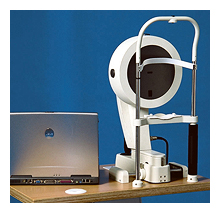
Oculus Pentacam.1,2,3,4
Another useful method uses the Oculus Pentacam, which images the anterior
segment of the eye with a 360° rotating Scheimpflug camera, generating
information in three dimensions.
During the two second measuring sequence, a total of 25,000 data points are
generated which includes the center of the cornea. All keratometers and corneal
topographers do not see the corneal center and are forced to extrapolate this
information, which gives the Pentacam this unique advantage in terms of accuracy.
The Equivalent K Reading
he Equivalent K Reading feature of the Pentacam uses information from both the anterior and the posterior cornea to generate a range of central corneal power values in keratometric diopters. Depending on the EKR zone selected, this value can then be used with the Holladay 2 Formula for IOL power calculations following keratorefractive surgery, or with one of the popular a 3rd generation, 2-variable formulas combined with an Aramberri "Double K" method
correction.
The Equivalent K Reading report is a recent software upgrade that can be easily
installed by every Pentacam user. This new feature was developed by Oculus
together with Dr. Jack T. Holladay to improve the measurement of the central
corneal power for patients who have undergone prior keratorefractive surgery.
For both myopic and even hyperopic LASIK, the 4.5 mm EKR zone has been shown
to have a high correlation with the central corneal power calculated by the
clinical history method.3
However, depending on the type of ablation employed,
some surgeons are finding a better correlation for myopic LASIK using a smaller
EKR area, such as the 3.0 mm EKR zone.4
In our practice we have found the EKR feature of the Oculus Pentacam to
be a very useful augmentation to other central corneal power estimation
techniques for the eye with prior myopic LASIK.
References
1. Hill WE. IOL power calculations following keratorefractive surgery. Presented
at Cornea Day of the Annual Meeting of the American Society of Cataract and
Refractive Surgery, San Francisco, California, March 17, 2006
2. Holladay JT. Measuring corneal power after corneal refractive surgery.
Insert to Cataract and Refractive Surgery Today. January, 2006. 4-6.
3. Holladay JT, Hill WE, Steinmüeller A. Corneal Power Measurements
Using Scheimpflug Measurements for Patients with Prior Refractive Surgery. Journal
of Refractive Surgery. In review.
4. Hill WE. IOL power calculations after keratorefractive surgery. Supplement
to Cataract & Refractive Surgery Today. February, 2008, pp. 1 – 3.
|